Showing posts with label Egg Experiments. Show all posts

Sunday, February 13, 2011

Fresh egg or Rotten egg Part 2

Part 2

Sink or Float

We know that a fresh egg ALWAYS sinks to teh bottom in glass jar but what of we change the scenario?

To find out

How does the fresh egg behave in salty water?

You need

A fresh egg (we used the same fresh egg from the above experiment), a clear glass jar. salt and fresh tap water.

What to do

First make a very salty solution in the glass jar. Then carefully put the fresh egg in the jar. (I used a table spoon to put the egg in). What happened was quite interesting. 

Fresh egg floating in Salty water
Notice the water level
The fresh egg that a had just sunk, to the bottom in the last experiment, now stayed afloat.

To make sure if this was because of the salty water. I tried out the next part of the experiment. Tilting the salt water slightly, I now poured fresh tap water in the jar, trying my best not to disturb the salt water. What happened now was even more amazing.

Fresh egg bobbing in the middle.
Notice the water level
This time the egg bobbed about a bit and then stayed in the middle of the jar. WHY? It began to sink down through the fresh tap water on the top, but as soon as it hit the salt water level below, it stopped, as it is denser.


This brought us to discuss the Quranic Ayah 53 of Surah 25 regarding the sweet and salty water not mixing.


You can read about it in detail here.

SUBHANALLAH!


Reference Sites:


Fresh egg or Rotten egg Part 1

Part 1

Good egg Bad Egg

To find out
How to tell a rotten egg from a fresh egg without braeking it.

You Need
2 fresh eggs, a digital weighing scale, to clear glasss jars, water and a lot of patience.

Preparation


For  this we weighed eggs and picked two that weighed the same. We placed them in water and they stayed at the bottom flat on their sides, like this.


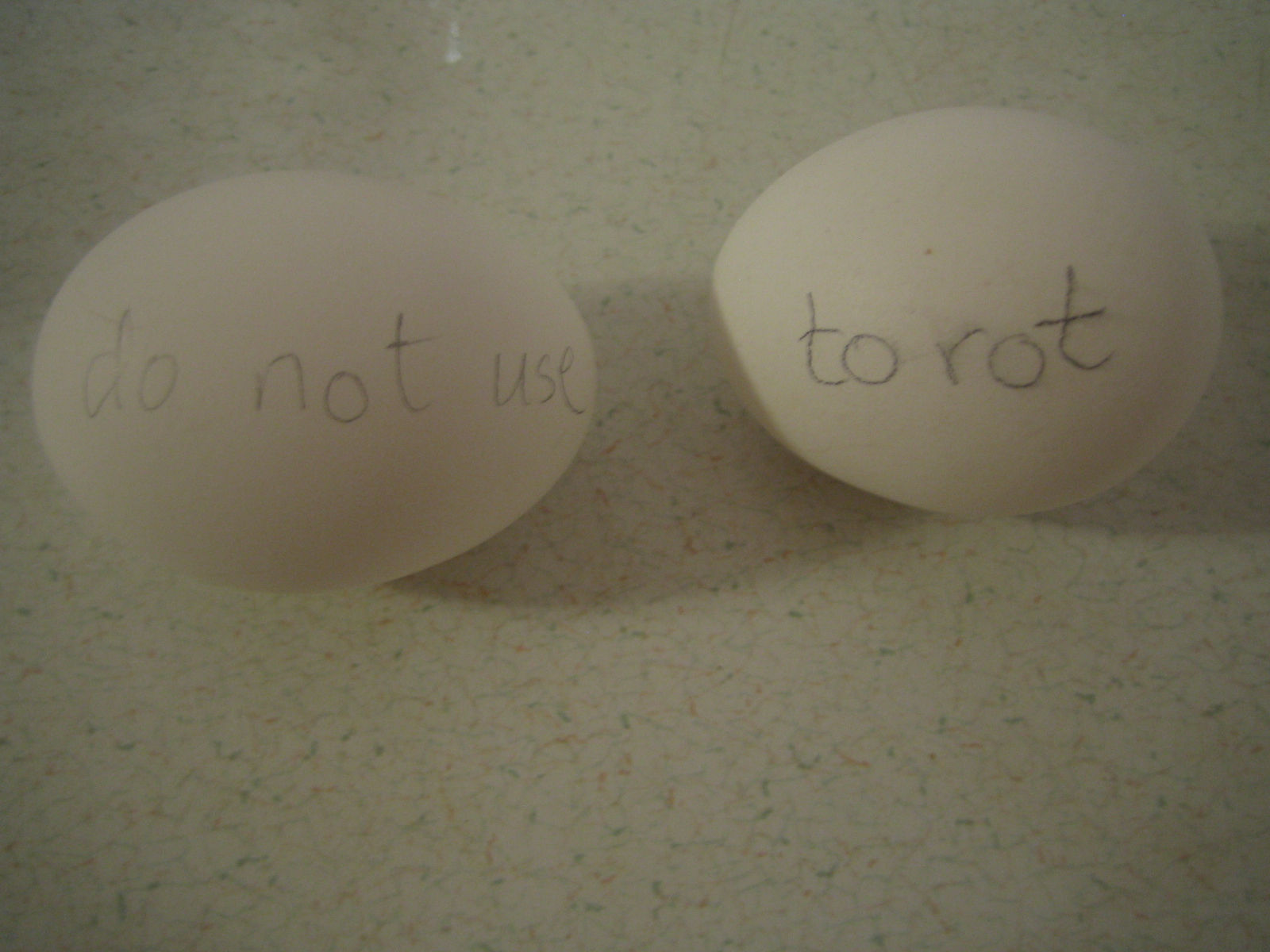
The eggs we chose weighed 61 gm each. We marked them "do not use" and "to rot" so we wouldn't use them by mistake. One was left in the fridge and the other outside to rot. 


Our Findings

After a week we weighed both the eggs. The one that wa sin teh frdige still weighed 61 gm, while the "to rot" egg weighed 57  gm, 4 gm less showing it had lost some of its moisture through it's semi-permeable membrane.

We placed the now lighter "to rot" egg in water and this time it did not lie horizontally but lifted up slightly standing on its tip. hhmm interesting.

After 2 weeks we weighed the egg again. It now weighed 54 gm That is 7 gm less than it's original weight. Our other egg had been left out by mistake for 2 days and apparently it had also lost some of it's moisture and weighed 2 gm less that is 59gm.

No we placed both the eggs in water to see what would happen? 

Here's what we saw.


The egg "to rot" egg  stayed afloat, and the other egg stood slightly on its tip. 

My Lil Muallims tried pushing it down with their finger a couple of times but bobbed right back up.

 WHY?
ochef.com says:


"There is a small air pocket in the large end of the egg. When the egg is fresh, the pocket is only about 1/8th of an inch deep and as large around as a dime. As the egg ages, however, it loses both moisture and carbon dioxide — shrinking — so that the size of the air space increases. And the size of the air space determines the buoyancy of the egg."

We noticed  the big air sac for ourselves by cracking teh egg. In comparison to the air sacs of other eggs we have been noticing for the past weeks, (at breakfast time) this one was surely bigger.

See for yourself!


Subhanallah!

Click  HERE for Part 2 of this experiment


Wednesday, February 9, 2011

Experiment - Organic Egg vs Regular Egg


Shell Eggsperiment

Organic vs Non Organic


After Experiment # 1 it was only natural to wonder how long would it take an organic egg shell to dissolve. 


Hypothesis


As the organic egg shell is thicker and stronger than the regular egg shell, it will probably take longer to dissolve in vinegar (acetic acid).


Materials Needed:


Organic egg shells
Regular egg shells
2 small ziplocs or bottles
Vinegar
Dish to hold them.


Procedure:


  1. Place each of the egg shells in a separate ziploc.
  2. Pour equal amount of vinegar in each and close it tight.
  3. Keep checking the bags every few hours and make observation.
  4. Open the ziploc and check the state of the egg shells after a day
  5. Check the difference again the 2nd day.


Observations:

#1 Within a few minutes of pouring vinegar into the ziploc bags bubbles started to form, showing air escaping from the egg shells. This is actually the reaction of vinegar (acetic acid) with the calcium carbonate crystals, forming carbon dioxide gas.

# 2 After about 20 minutes there were lots of bubbles collected on top of the vinegar.


#3 After a couple of hours the organic egg shell bag seemed to have some reddish brown pigment floating in the bag. (Not sure what it was).


# 4 The bags also looked looked puffed up, showing that they were full of carbon dioxide. 


NOTE:We had to open the bags and release the air , fearing the ziploc bag might burst. In this sense we were glad we used ziplocs cause it showed and proved the constant production of carbon dioxide due to the reaction between the egg shells and vinegar.

We decided to double check and release some gas again from the bags before going to bed.

# 5 On the next day a piece of  the regular egg shell crumpled easily, when rubbed between two fingers. The organic egg shell pieces looked less disintegrated but were also crumpling easily.

# 6  On the 3rd day on taking out the egg shell the second inner membrane was also visible as it separated in the regular egg shell. The egg shell had completely disintegrated and was clinging to the membrane like wet powder. The small shell pieces, floating in the vinegar, turned into a powdery paste when rubbed between the finger.


# 7 The organic egg shell had softened up more but was till visible in pieces clinging to the inner membrane.

All the white paper like material around the organic shell is actually is its inner membrane

Conclusion:

The regular egg shell reacted faster with the vinegar than the organic egg shell proving the hypothesis. 


Reference Site:
http://www.stevespanglerscience.com/experiment/00000023


http://www.everythingesl.net/lessons/egg_experiments.php


http://archive.planet-science.com/parents/easter_pdfs/eggbox.pdf

Experiment - Whitening Teeth

Whitening Teeth and Eggs


Hypothesis


Fluoride whitens teeth.


Materials Needed


A hard boiled with its white egg shell
Coke (any black drink)
Glass bottle
Any fluoride Tooth Paste
Old Tooth Brush


Procedure


Leave the egg in a glass in coke in a glass bottle for a day. Note the difference in the egg shell after a day. Clean the egg shell with toothpaste and tooth brush.


Observation


# 1 After a day the white egg shell was discolored and turned brown.


#2 When rubbed with fluoride tooth paste with a tooth brush the egg shell turned white again.


Conclusion


Fluoride helps clean and whiten teeth.

Monday, January 24, 2011

Experiment - Egg Motion

Learning Law of Motion with an Egg

A Spinning Eggsperiment

Materials Needed:

2 eggs: 1 hard boiled, 1 raw

Procedure:

Spin the two eggs and then gently stop them with a finger.

Observation

What happens when you stop the eggs?

source


EXPLANATION

I took a whole hard boiled egg and a whole raw egg (with the shell), and told the kids that I was going to show them something interesting with the two eggs. You can also have it ready from before then ask the kids which one is boiled which one is not? They might guess it right but there is no way to be sure. So what do you do?


Spin the Eggs. 


source


I told my Lil Muallims to pay close attention to the eggs and to notice which spins well and which one spins slow. While the eggs were spinning I tough them gently with a finger to stop them, and then quickly moved away my finger. They were surprised to see what they saw.


(I couldn't get a picture of the eggs spinning... they lookes so nice!!)


What Happened?

One egg stopped while the other kept spinning slowly for a few more seconds. 


Why?


I asked the Lil Muallims why?


I could see deep thinking on their faces.


Then I asked then what happens when we are all driving in a car and baba has to push the breaks suddenly?


Lil Muallims in unison: "We move forward?"


Me: "Why? That's a little physics for you here. That's because even though your are sitting still you are supposed to be moving in the same direction and in same motion as the thing you are travelling in. So even when baba hits the breaks and the car stops, because you were moving with the car, you first bend forward..... proving you motion.


So why do you think the egg is still moving?"


Lil Maullim thinking: "Probably because the liquid inside the egg was still moving"

Alhumdolillah! Great Answer Mashallah!

The following explanation from Steve Spangler's web site explains it simply

Hardboiled or Raw?
"Can't remember which egg is which? The answer is only a spin away. Simply spin the egg and pay close attention to how well it spins. If the egg spins well, it's hardboiled. However, if the egg wobbles and spins slowly, it's raw. A hardboiled egg is solid inside whereas a raw egg is fluid. When you spin the raw egg, its center of gravity changes as the fluid inside the egg moves around. This results in the wobbling motion you noticed in the raw egg. As soon as the raw egg starts spinning, touch it briefly with your finger just long enough to stop it. When you take your finger away, the egg will continue to spin for just a quick second. This is due to the inertia of the fluid inside the egg. When the hardboiled egg is spun, the solid center immediately moves with the shell, causing little resistance to the spinning motion."


What we learnt ?

.To tell which egg is boiled which one isn't simply test them for inertia.


What is Inertia


Simply put Inertia is: 

"An object in an object at rest  remains at rest and an object in motion remains in motion, till an outside force is applied to it"

This is Newton's first law of motion

If you want to study this concept in more detail......


 To study Laws of Motion visit our Lil Muallim Blog


Thursday, January 20, 2011

Experiment - Cellular Membrane and Osmosis

Lil Muallim # 1 "Cellular membrane and  Simple Osmosis"


Studying the basic structure and characteristics of a cell and it's membrane.


What I know :


The egg is actually the largest cell in the world. The calcium carbonate makes up its outer shell. It is made up of  calcium carbonate (CaCO3) crystals. This is just an outer coating protecting the actual cell membrane. The cell membrane encloses the eggs yolk (nucleus) and white (cytoplasm).


Simple anatomy of an egg can be learnt here


Materials Needed:
An egg
Clean glass wide necked bottle


vinegar coffee maker
Regular white vinegar


image-80-tap-water
Water

Paper Towel


Procedure:

  1. Place an egg in a medium sized jar.
  2. Fill the jar with vinegar until it covers the egg
  3. Leave it for 3-5 days
  4. On the 4th or 5th take out the egg and wash it gently with water removing the powdered calcium coating
  5. Observe the egg in the dark with a torch
  6. Place the egg on absorbent paper towel and try touching it gently
  7. Leave it like this for about a day
  8. Place the dehydrated egg in a bowl of water overnight

Observations

#1 Bubbles started forming inside the jar as the acetic acid in the vinegar starts to react with the calcium carbonate crystals in the egg shell.

# 2  After a day in the vinegar the egg shell started softening.

# 3 The appearance of  the egg shell changed as its chemical composition changed. The solid Calcium Carbonate crystals broke apart in the acetic acid releasing carbon dioxide gas.


# 4 The calcium turned into powder and was easily removable when rubbed gently


# 5 The egg looked slightly larger because it had absorbed some of the vinegar, showing that the cellular membrane is semi permeable (can pass through some air and moisture) and osmosis (simply the transfer of molecules from one medium into the other).


# 6 The cellular membrane is translucent and the yolk can be seen bobbing in egg white (albumen) through it, because of it bright color 


A raw egg with it's egg shell dissolved

(you can also try looking at it in dark with a torch I couldn't get a clear picture with my camera but this website shows how we saw it) 


# 7 The egg was bouncy showing the elasticity of the cellular membrane as it is partly made up of keratin (a fibrous protein)


# 8 When left to dry out on an absorbent paper towel the egg shrivels up as it paper towel absorbed the moisture from egg. This again shows the semi permeable characteristic of the cellular membrane 


# 9 When the dehydrated egg is placed in water, it restores its shape as it regains moisture through osmosis.


# 10 It is still bouncy as before. Subhanallah!


Conclusion:


The cellular membrane encloses and protects the inner parts of the cell, It is stretchy because of keratin a string fibrous protein. It is also translucent. Osmosis can easily take place as the cellular membrane is semi permeable.


WATCH VIDEO

The egg does bounce watch it in this video I found 


NOTE: We used the same egg frim Lil Muallim # 2's experiment and we did the dehydration and hydration part twice on the same egg and it worked perfectly.\After the second hydration it was still bouncing as the first time.

SUBHANALLAH

LinkWithin

Related Posts Plugin for WordPress, Blogger...